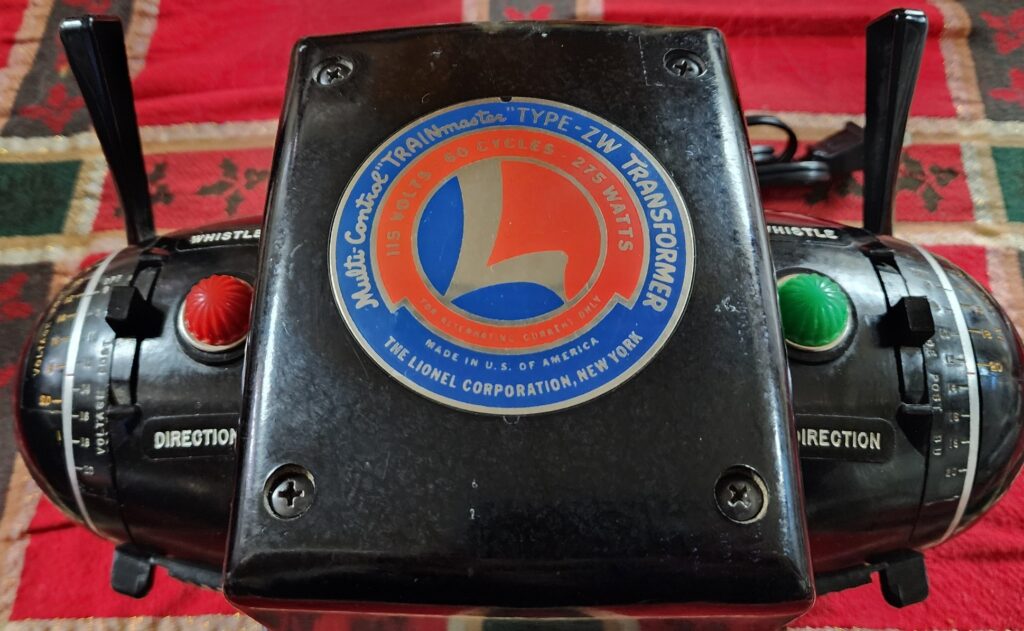
The Lionel Trainmaster Type-ZW Transformer is more than a piece of model train equipment; it’s a symbol of nostalgia, reliability, and power.
From 1948 to 1966, this iconic transformer served as the backbone of countless layouts, earning a reputation as the ultimate choice for serious hobbyists. Its rugged construction and impressive performance made it a standout during Lionel’s golden era, and today it continues to hold a special place in the hearts of collectors and operators alike. This article explores the history, features, and enduring appeal of the legendary Lionel ZW Trainmaster Transformer.
Introduced in 1948, the ZW quickly became the crown jewel of Lionel’s postwar power lineup. At a time when electric trains were more than toys; they were a centerpiece of family traditions. The ZW distinguished itself with unmatched capacity and versatility. Originally rated at 250 watts and upgraded to 275 watts in 1950, it was engineered to handle large, complex layouts with ease, powering multiple trains and accessories simultaneously. Its distinctive design, featuring dual throttle handles and a sleek, durable Bakelite shell, made it instantly recognizable and highly desirable. Over the years, the ZW became synonymous with quality and performance, setting the standard for what a transformer should be.
The Lionel ZW didn’t simply power trains; it powered imaginations. For nearly two decades, it stood at the center of the postwar Lionel experience, becoming the transformer that defined an era. Its combination of strength, control, and presence made it the undisputed command center of countless layouts, from Christmas tree loops to sprawling empires.
As layouts grew, the ZW delivered unmatched power.
- Its 250-watt output, later increased to 275-watts gave operators the freedom to run multiple trains, accessories, and illuminated passenger consists without hesitation.
- The internal design, built around a massive, laminated core, provided smooth, stable voltage that kept locomotives running reliably even under heavy loads.
- Four independent outputs meant one transformer could orchestrate an entire miniature railroad.
For many families, the ZW wasn’t just the biggest transformer Lionel made; it was the one that made the whole layout feel alive.
A Control Experience Like No Other
The ZW’s dual throttle handles became iconic. Their long, sweeping motion offered a tactile sense of control that modern digital systems simply can’t replicate.
- Operators could “feel” the train accelerate.
- The resistance of the handles gave a sense of precision and authority.
- The ZW’s physical presence is a major reason the ZW remains beloved today. Running trains with a ZW feels like operating a machine, not just pressing buttons
Built to Outlast Generations
Lionel engineered the ZW during a time when American manufacturing durability was a point of pride.
- Heavy-gauge windings
- Oversized internal components
- A thick Bakelite shell
- A breaker designed to protect both the transformer and the trains of its day.
The result is a transformer that, even 60–70 years later, often needs nothing more than fresh rollers and a new cord to return to service. Many hobbyists still use the same ZW their parents or grandparents operated, a testament to its remarkable longevity.
As with all postwar transformers, the ZW’s internal breaker reacts too slowly to safeguard modern electronics. Even early Sound boards can be damaged by accidental spikes and surges.
Outfitted with TVS diodes and a fast‑acting external breaker, the ZW is perfectly capable of running modern trains safely.
A Fixture of American Holiday Tradition
For countless families, the ZW was part of the holiday ritual. It sat proudly beside the Christmas tree, its warm glow of lights and the sound of trains circling the room. The ZW became a symbol of togetherness a shared experience passed from one generation to the next.
Even today, collectors speak of the ZW with a mix of nostalgia and reverence. It represents a time when toys were built like machines and childhood memories were powered by the ZW’s AC magic.
The Standard by Which All Others Are Measured
Modern transformers including Lionel’s own ZW‑L owe their lineage to the original. Yet none have matched the cultural impact of the postwar ZW. It remains the benchmark for:
- tactile control
- raw power
- reliability
- emotional connection
The ZW didn’t just power trains – It powered an era.
Power Output and Ratings
The ZW’s defining characteristic was its impressive wattage, which evolved during its production run:
- 1948–1949: Rated at 250 watts
- 1950–1966: Upgraded to 275 watts, the rating most collectors recognize today.
This power allowed the ZW to run:
- Multiple trains simultaneously
- Accessory circuits
- Illuminated passenger cars
- Switch machines
- Operating accessories Even by modern standards, the ZW’s output remains formidable.
Four Independent Outputs
The ZW offered unmatched control flexibility through four variable outputs:
- A and D handles: Full-range throttle control; 0–20 volts AC
- B and C posts: Adjustable via the internal rollers but typically used as fixed-voltage accessory taps
This configuration allowed operators to:
- Run two trains independently
- Power accessories at custom voltages
- Feed isolated track blocks
- Create complex, multi-train operations with a single transformer
The ZW’s versatility is one of the reasons it became the centerpiece of so many layouts.
Internal Construction and Engineering
Lionel built the ZW with a level of durability that bordered on industrial:
- Massive laminated steel core for stable voltage under load
- Heavy-gauge copper windings designed for long-term reliability
- Dual carbon rollers on each throttle for smooth voltage delivery
- Bakelite shell that resisted heat, impact, and warping
- Robust internal wiring capable of handling sustained high current
This overbuilt design is why so many ZWs remain operational 60–70 years later. A fully refurbished ZW can last another 50 years.
Physical Specifications
The ZW’s imposing size contributed to its iconic status:
- Height: ~7 inches
- Width: ~11 inches
- Depth: ~7 inches
- Weight: Approximately 11 pounds
Its large footprint and sweeping handles gave it a commanding presence on any control panel.
A Legacy That Still Powers On
The Lionel ZW Trainmaster Transformer stands as one of the most enduring symbols of the postwar model railroading era. Its unmatched power, rugged engineering, and intuitive control design made it the transformer that generations of hobbyists trusted at the center of their layouts. More than a technical achievement, the ZW became a cultural icon — a fixture of holiday traditions, a gateway to childhood imagination, and a piece of equipment built so well that many units still operate today with only minimal maintenance.
Its influence continues to shape the hobby. Modern transformers may offer digital features and advanced electronics, but none have replaced the tactile satisfaction or emotional resonance of the original ZW. It remains a benchmark of reliability and craftsmanship, a reminder of a time when toys were built like machines and families gathered around the glow of a layout powered by 275 watts of excitement.
For collectors, operators, and enthusiasts, the ZW is more than a transformer. It is a legacy, one that continues to hum to life, with memory, and the timeless magic of Lionel railroading.